
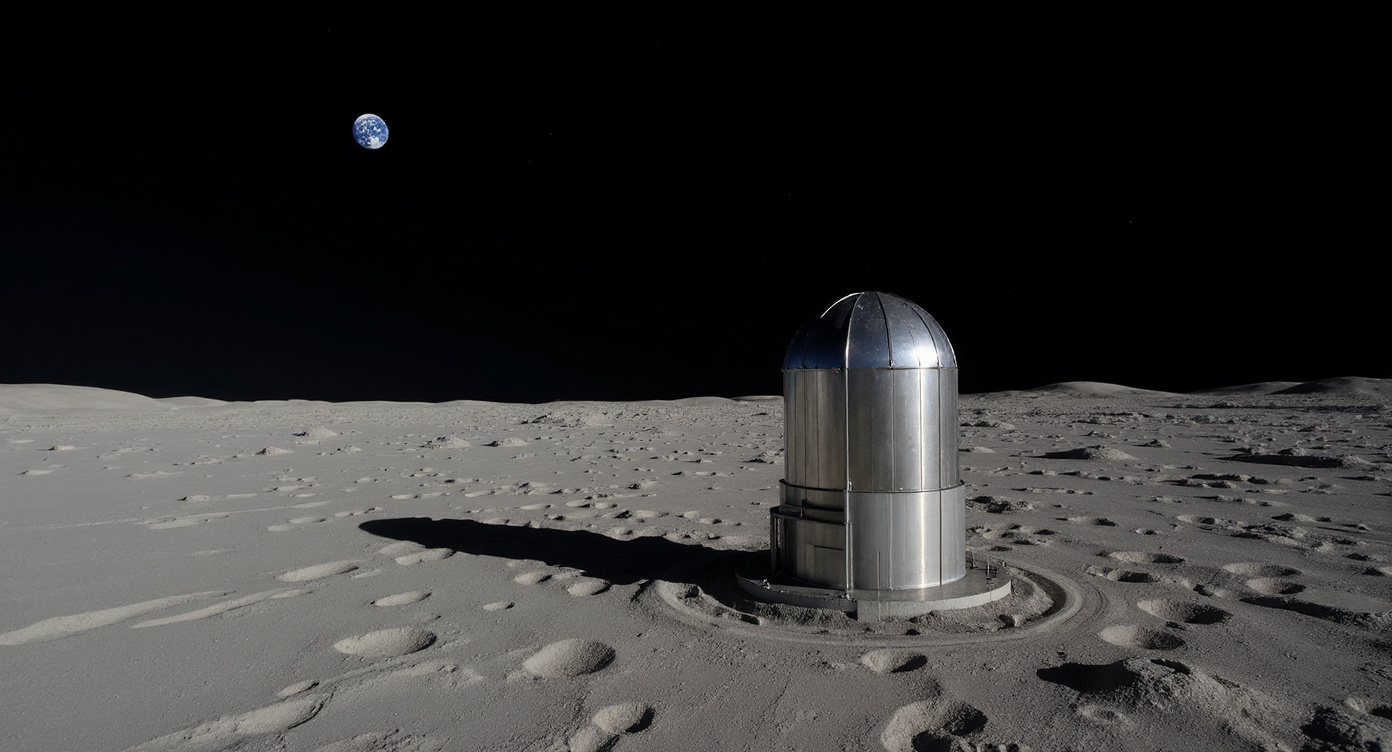
In late August, NASA quietly reached out to contractors with an unusual request: build a compact nuclear reactor capable of surviving a quarter-million-mile space voyage, landing near the moon's south pole, and running for five years without a single human being touching it. Deadline: December 2030.
Russia and China are building one too.
NASA Administrator Jared Isaacman confirmed the accelerated timeline as part of President Trump's America First Space Policy, which specifically directs the agency to deploy nuclear reactors on the Moon and in orbit. "America is committed to returning to the Moon, building the infrastructure to stay, and making the investments required for the next giant leap to Mars and beyond," Isaacman said in a joint announcement with the Department of Energy on January 13, 2026.
The reactor — designated Lunar Reactor 1 — would produce 20 kilowatts of electricity, roughly enough to power 16 American homes. That doesn't sound like much until you consider the alternative: solar panels that go dark during the lunar night, which lasts 14 Earth days at a stretch, and batteries with lifespans measured in months. Nuclear runs regardless of sunlight, regardless of temperature, and doesn't need refueling.
Energy Secretary Chris Wright framed the partnership in terms the space bureaucracy rarely hears. "History shows that when American science and innovation come together, from the Manhattan Project to the Apollo Mission, our nation leads the world to reach new frontiers once thought impossible," Wright said when the DOE and NASA signed their memorandum of understanding.
Congress included $250 million for the reactor in fiscal year 2026 spending legislation. The DOE's Idaho National Laboratory estimated the full five-year cost at $3 billion. Lockheed Martin already holds a Phase 1 contract for what's formally called the Fission Surface Power system and has been developing the concept since a June 2022 award.
Russia's Kurchatov Institute is developing a reactor called Selena, designed to produce 10 kilowatts and operate autonomously for a decade. Mikhail Kovalchuk, the institute's president, told TASS that "Russia has practically no competitors in the field of space nuclear energy." That claim aged poorly the moment NASA published specs for a reactor with double the output. Russia aims to have Selena operational by 2036 as part of a secretive partnership with China. NASA moved its own deadline forward specifically to beat them.
The stakes go beyond bragging rights. Whoever controls lunar power infrastructure controls access to the moon's south pole, where frozen water deposits could supply fuel and oxygen for missions deeper into the solar system. Both the United States and China want permanent bases there. A nuclear reactor isn't an accessory to that plan. It's the centerpiece.
The Union of Concerned Scientists — reliably concerned about the wrong things at the wrong time — has raised objections. Edwin Lyman, the group's director of nuclear power safety, warned that entering nuclear power into the space race "could take a potentially more dangerous turn." Russia launched more than 30 reactors into space between the 1970s and 1980s, including one that scattered radioactive debris across northern Canada in the late 1970s. What Lyman's warning conveniently omits is the alternative: ceding lunar infrastructure to a Russia-China partnership operating with zero international oversight and a track record that includes a lander crash within the last six years.
The United States has spent $20 billion on space nuclear programs since 1965 with almost nothing to show for it on the launchpad. What changed isn't the technology — compact fission reactors have been viable for decades. What changed is that a president issued a directive in December 2025 that didn't commission another study or request a feasibility review. It set a date.