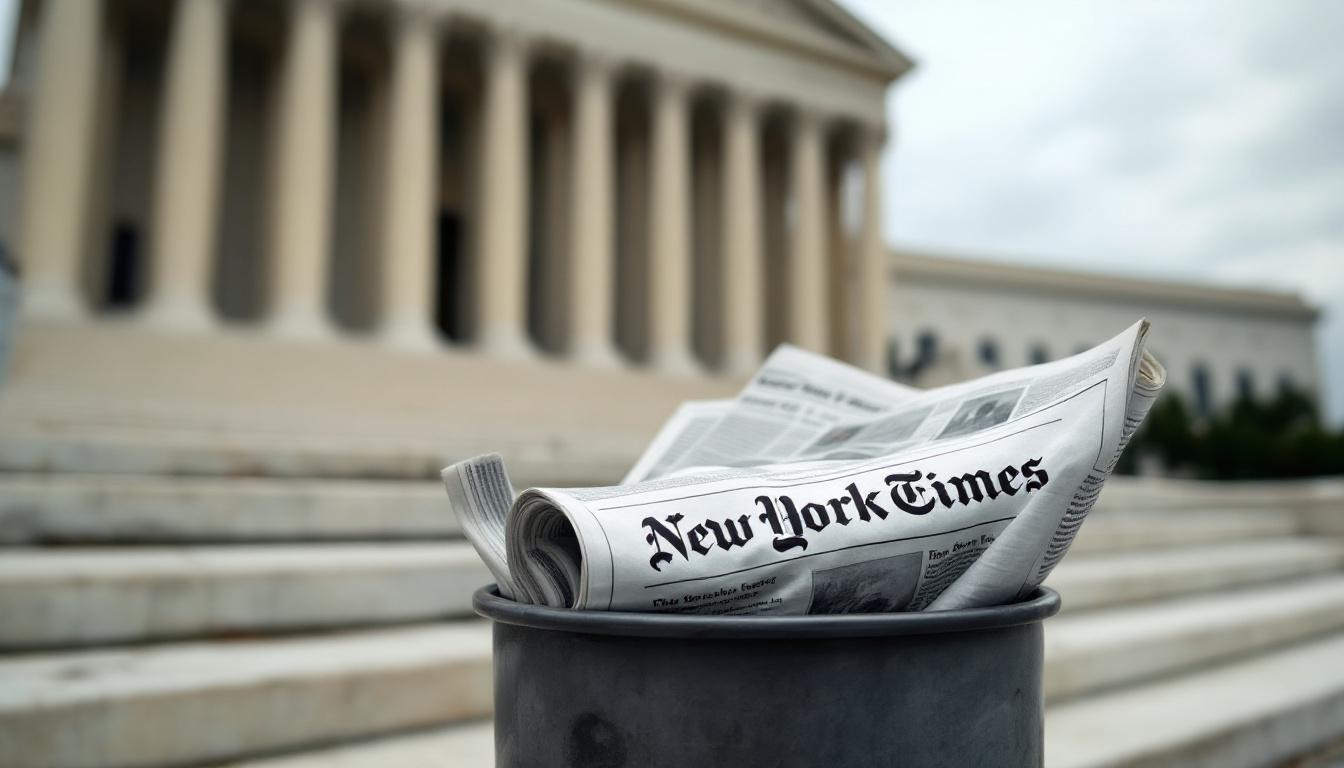
The New York Times — the self-anointed “paper of record” — just got busted distorting internal Supreme Court documents to make the justices look like political hacks. We’re talking about leaked internal memos from the Court’s emergency docket, and the Times took those memos, twisted what they actually said, and served up a heaping plate of garbage to their readers as if it were filet mignon.
The irony is so thick you could spread it on toast. This is the same newspaper that has spent the last decade screaming about “misinformation” and “threats to democracy” and demanding that social media companies censor anyone who disagrees with their editorial board. And here they are — literally altering the record.
Here’s what happened. The Times got their hands on what are called “shadow papers” — internal Court documents related to the emergency docket. These are the expedited rulings the Supreme Court issues without full oral arguments, covering things like immigration stays, COVID policies, and abortion restrictions. Routine stuff that’s been happening since 1973 when the Court started handling emergency orders related to the Cambodia bombing cases.
But “routine internal memos” doesn’t exactly sell newspapers, does it?
So the Times did what the Times does best. They slapped on sensational framing designed to make it look like the justices were engaged in some shadowy political conspiracy. They took boring procedural documents and presented them as smoking guns. Jack Goldsmith — that’s the Learned Hand Professor at Harvard Law School, not exactly a right-wing blogger in his basement — published a devastating critique of the whole thing on his Substack.
Goldsmith’s argument is straightforward: the Times exaggerated the significance of routine internal memos while conveniently ignoring the fact that shadow docket cases have inherent limitations by design. These rulings are fast because they’re supposed to be fast. They’re emergency orders. That’s the whole point. But the Times wanted readers to believe that “fast” means “politically motivated” because that’s a better story for their subscriber base of wine moms in Brooklyn who need something to panic about between yoga classes.
(They’re charging $17 a month for this fiction, by the way. Ka-ching!)
And we need to talk about the leak itself. Someone inside the Supreme Court decided to hand these documents to the New York Times. Sound familiar? It should. This is the same institution that suffered a massive breach of confidentiality in 2022 when the Dobbs opinion was leaked before it was officially released. That leak sent the Left into a frenzy and nearly got justices killed — a man literally showed up at Brett Kavanaugh’s house with a gun.
So who’s leaking these documents, and why? The Times doesn’t care to explore that question, naturally, because asking “who benefits from selectively releasing internal Court documents to a left-wing newspaper?” might lead to some uncomfortable answers about their own sources.
Pop quiz: What do you call it when a newspaper takes official documents, changes what they say, and publishes the altered version as fact?
If a conservative outlet did this, the Times would call it “disinformation” and demand congressional hearings. When THEY do it, it’s called “investigative journalism.” Unbelievable.
The whole scheme was so transparent that even Reason.com — a libertarian outlet that doesn’t exactly carry water for the Republican Party — highlighted Goldsmith’s takedown on April 20th. When the libertarians are calling you out for journalistic fraud, you’ve really stepped in it.
This is who these people are. They don’t report the news — they manufacture it. They take a stack of procedural memos that would put a law student to sleep, sprinkle some “democracy is dying” seasoning on top, and serve it to an audience that’s been trained to salivate at the sound of the words “Supreme Court” and “leaked documents” in the same sentence.
Meanwhile, we’re supposed to trust these same people to tell us the truth about elections, about the economy, about foreign policy, about everything. The “paper of record” can’t even accurately report what a document says when they’re holding it in their hands.
If you’ve still got a New York Times subscription, congratulations — you’re paying a billion-dollar media company to lie to your face and then lecture you about the importance of “facts.” Maybe cancel that and buy yourself a nice steak instead. At least the cow was honest about what it was.