
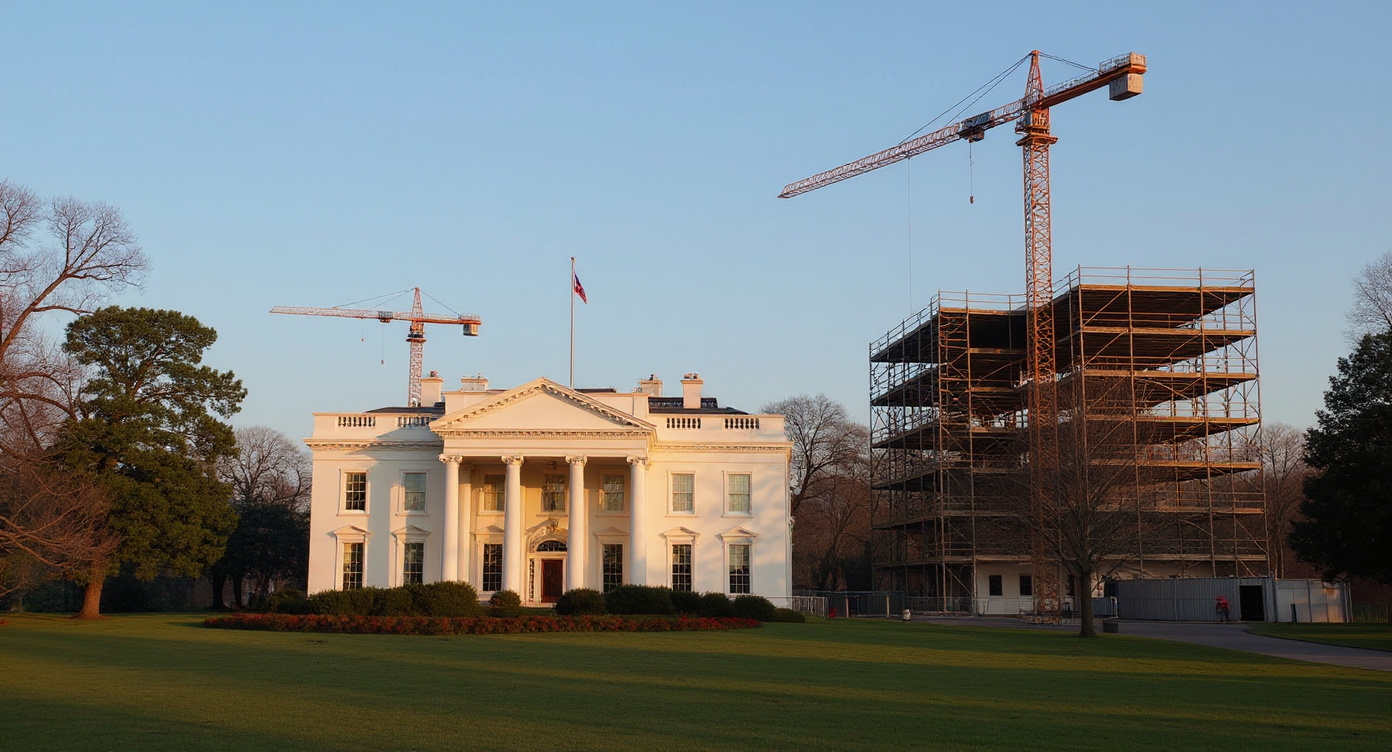
A 250-person construction crew has been working 20 hours a day, seven days a week, on a 90,000-square-foot addition to the White House. On Friday, Chief Justice John Roberts signed a one-page order that says they can keep going.
The National Trust for Historic Preservation is not taking it well.
Here's the backstory. President Trump announced plans for what he calls the "Military/Ballroom Complex" back in October 2025, unveiling a $250 million rendering of the project. The East Wing — the first lady's office wing — was demolished to make room for a secure facility that Trump says will include bomb shelters, a hospital, sniper nests, and a drone port. The project has since ballooned in estimated cost, with figures ranging from $300 million to $600 million depending on who's counting.
The National Trust for Historic Preservation filed suit arguing that Congress never authorized the project, and that presidents can't just tear down parts of the White House and build whatever they want without legislative approval. U.S. District Judge Richard Leon — a Republican appointee, worth noting — agreed. Back in March, Leon ruled that construction had to stop unless the work involved safety and security features only. He later clarified: below-ground work could continue, but above-ground construction was prohibited.
The Trump administration appealed. The D.C. Circuit Court of Appeals initially allowed construction to continue while the case moved forward. Then Judge Leon's injunction kicked back in on April 16, halting above-ground work again.
So the administration went to the Supreme Court. And on August 21, Chief Justice Roberts issued an administrative stay — putting Leon's injunction on hold "pending further order" from Roberts or the full Court. Above-ground construction resumes. The cranes keep swinging.
The National Trust filed its opposition brief on August 18, three days before Roberts acted. Their argument included a line that tells you everything about how this fight has gone for them: "Rather than obtain permission from Congress, Petitioners have instead decided to try to outrun judicial review." Which is a creative way of saying the building is going up faster than the courts can stop it.
Trump, naturally, was restrained and measured in his response. Just kidding. He posted on social media: "We are grateful for the Decision of the United States Supreme Court. The Military/Ballroom Complex being built on the hallowed grounds of the White House, which is so vital for National Security, will be THE GREATEST OF ITS KIND!"
He followed up: "It's all tied together as one big, expensive, and very complex unit, which is vital for National Security and Military Operations of the United States of America!"
Now, opponents of the project point to an April 2026 Washington Post-ABC News-Ipsos poll showing 56% of Americans disapproved of Trump's decision to demolish the East Wing and build the ballroom. But 56% of Americans also couldn't tell you what the East Wing was used for before it got torn down. Polling on construction projects at the White House isn't exactly a constitutional argument. The legal question is whether Congress needs to authorize it — and so far, the only Supreme Court justice who's weighed in has sided with the president.
The construction has closed off the north side of the White House and Lafayette Park to the public. That's a real consequence. But the administration's argument — that the facility is an "integrated military complex" critical to presidential security, citing actual assassination attempts against Trump — isn't something you can wave away with a historic preservation brief.
This is technically a temporary victory. Roberts's stay is administrative, not a final ruling. The full Court could lift it. The case could wind its way through more hearings, more briefs, more judicial hand-wringing about executive authority and federal property law.
But here's the thing about a 90,000-square-foot building going up 20 hours a day with a 250-person crew: by the time the courts issue a final ruling, there may not be much left to enjoin. Every day the stay holds is another day of steel and concrete. The National Trust wanted to freeze the project in place. Roberts unfroze it.
The administration said the project is "under budget and ahead of schedule." The courts said slow down. The Supreme Court said not yet.
That's not a final answer. But it's the only answer that matters today.