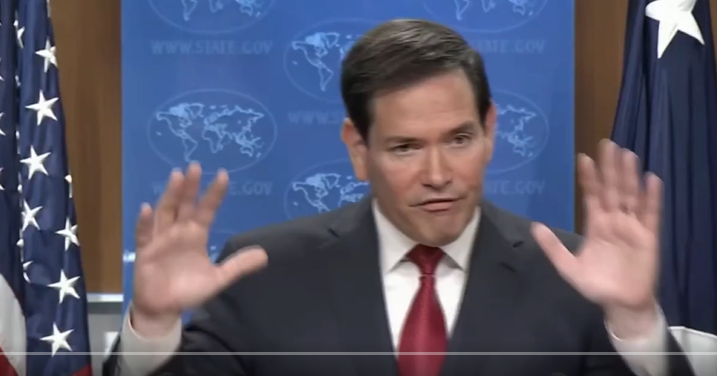
Secretary of State Marco Rubio sat across from NBC's Craig Melvin on the "Today" show Monday morning and said what roughly half the country has been muttering at their televisions for years. "Maybe you're not going to like to hear this," Rubio told Melvin, "but I watch a lot of American news coverage, and it sounds, in some cases, like they're rooting for Iran."
He said it on NBC. To an NBC host. While NBC's camera was rolling.
The interview was supposed to be about the White House's decision last Friday to revoke press credentials for CNN, MS NOW, and Politico — a move that sent all three outlets scrambling to file a joint lawsuit on Monday claiming "the government does not decide what the press reports or publishes." Melvin wanted outrage. He wanted Rubio to squirm. What he got instead was a calm, methodical dismantling of the entire premise.
"Why should I have people working in my building and in my office that I believe are not honestly covering my administration?" Rubio asked. The question landed like a brick on a glass table, mostly because there isn't a good answer to it. A White House press pass is not a constitutional right. It's a workspace arrangement. And the Trump administration decided three outlets had worn out their welcome in that workspace.
Melvin tried the emotional escalation. "They are banned! They're banned from The White House," he pressed, his voice rising as if volume could substitute for an argument. Rubio didn't match the energy. "We're not closing CNN," he replied. "They can cover The White House. They just can't have a desk there."
That distinction matters more than the coverage has acknowledged. Nobody is preventing CNN, Politico, or MS NOW from reporting on the president. Nobody is censoring their broadcasts. Nobody is seizing their equipment or arresting their journalists. They lost a reserved seat in a government building. The First Amendment protects the press from government suppression of speech. It does not guarantee a parking spot.
The lawsuit filed Monday by the three outlets frames the credential pull as an attack on press freedom itself. The filing states that "the government does not decide what the press reports or publishes" — which is true, and also completely irrelevant to what actually happened. The government didn't decide what anyone reports. It decided who gets a desk in the West Wing. Those are different things, and the outlets suing know it.
Rubio, for his part, told Melvin he hadn't even discussed the decision with the White House beforehand. "We haven't discussed it. This is a decision The White House made about coverage in The White House," he said. He wasn't there to defend a policy. He was there to point out something more fundamental — that the networks howling about being silenced are broadcasting their complaints to millions of people in real time, which is a strange thing for silenced people to be able to do.
The Iran line is the one that will travel. Not because it was a gotcha, but because it named the thing that has made White House press access such a contested issue in the first place. When outlets spend years framing every foreign policy development as a potential American failure, when coverage of adversaries reads more like admiration than analysis, the people in charge of handing out building passes eventually notice.
CNN can still file FOIA requests. Politico can still publish scoops. MS NOW can still run twelve-hour panels about authoritarianism. They just have to do it from their own offices.
Three outlets lost their desks. The lawsuit says the government is deciding what the press publishes. Rubio said they sound like they're rooting for Iran.
One of those claims is verifiable.