
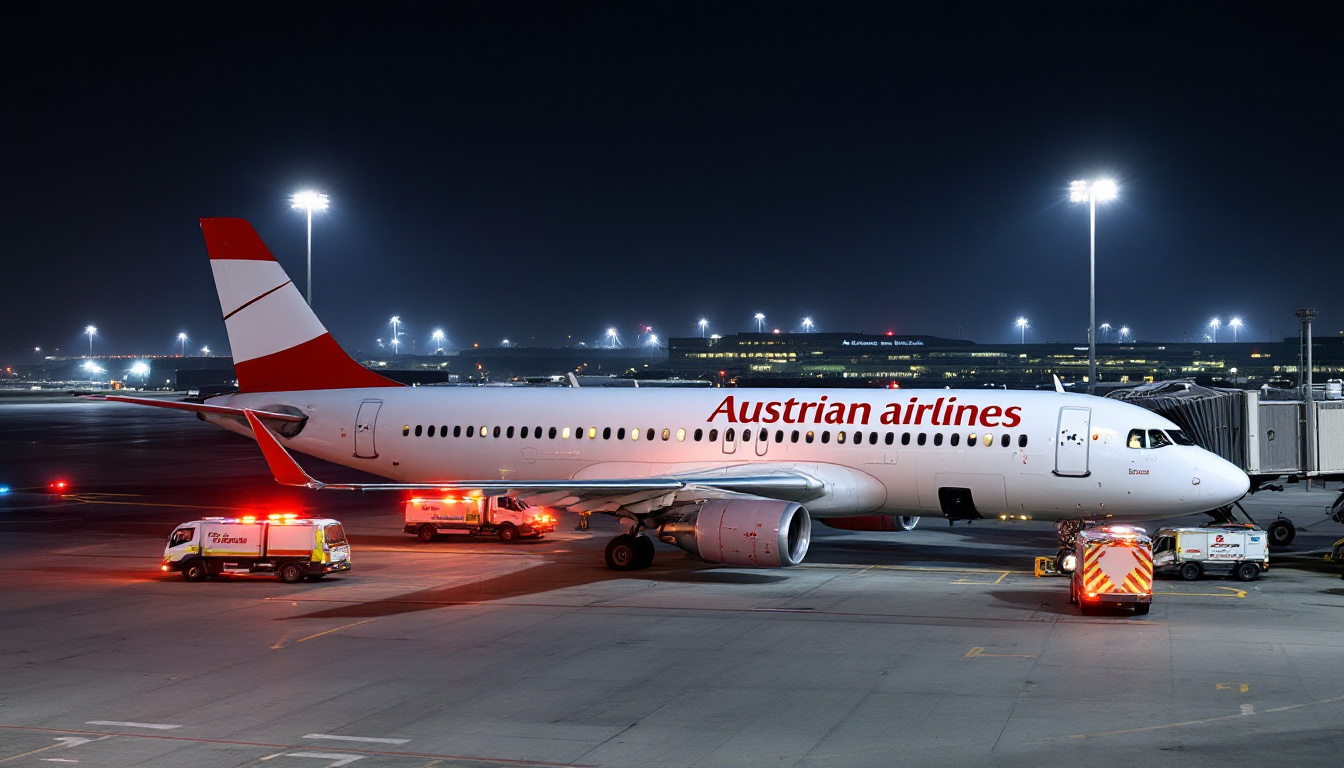
Fifty-one passengers and six crew members aboard Austrian Airlines Flight OS82 were cruising somewhere over the Balkans on Sunday evening when a Bulgarian Air Force fighter jet pulled alongside the aircraft and escorted it to an unscheduled landing in Sofia.
Someone had called in a bomb threat to Vienna's airport.
The flight, a routine Tel Aviv-to-Vienna run, transmitted Squawk 7700 — the international emergency distress code — and diverted to Sofia Airport, touching down at 8:42 p.m. Central European time. Bulgarian authorities from the Ministry of Transport confirmed the aircraft had received a "bomb threat signal," and security teams moved the 57 people on board off the plane under armed supervision.
Austrian Interior Minister Gerhard Karner confirmed the threat came via a telephone call placed directly to Vienna's airport. An Austrian Airlines spokesperson stated, "We can confirm that a threat was made against flight OS82 from Tel Aviv to Vienna, which necessitated a stopover in Sofia." The spokesperson added, "The safety of our passengers and crew is always our top priority."
After a thorough search of the aircraft, every piece of luggage, and all passengers and crew, Bulgarian security teams found nothing. "During the search of the affected aircraft, the passengers, and the crew, no danger was identified," the airline confirmed. No explosive device. No weapon. Just 57 people stranded in a Bulgarian airport because somebody picked up a phone.
Here's what's worth noticing about the sequence: the threat targeted a flight originating in Tel Aviv. Not a random European route. Not a domestic shuttle. A plane full of people who had just left Israel. The caller knew the flight number. Knew the route. Knew when to call Vienna to maximize disruption while the aircraft was still airborne over foreign airspace.
That level of specificity doesn't come from a bored teenager. It comes from someone who wanted to send a message — and who wanted that message attached to Israel.
The timing matters too. Threats against aviation tied to Israel have escalated alongside the broader climate of anti-Israel hostility that's metastasized from campus protests into something with operational ambition. We've watched "ceasefire now" evolve from chants to highway blockades to harassment campaigns against Jewish students. A targeted bomb threat against a commercial flight from Ben Gurion Airport is a different category, but it sits on the same trajectory.
Bulgarian authorities scrambled a fighter jet to escort a civilian airliner. That's not a precaution you take for a prank. That's a military response to a credible-enough threat that a NATO member state put armed aircraft in the sky next to a commercial plane carrying families.
The investigation is ongoing. Austrian and Bulgarian authorities haven't publicly identified a suspect or a motive. The passengers eventually continued their journey after the all-clear.
Fifty-seven people boarded a routine flight out of Tel Aviv on a Sunday evening. They landed in a country they weren't headed to, surrounded by security personnel and a fighter escort, because someone decided a phone call to Vienna was worth the trouble.
The plane was clean. The message wasn't.